Is a Partial Knee Replacement Right for You?
Category: Orthopedics
 Mon Apr 27 2026


Living with constant knee joint pain can make even simple daily activities feel impossible. If you are wondering whether you qualify for surgery, a candidate for a partial knee replacement is typically someone experiencing osteoarthritis confined to just one part of the knee, who has stable ligaments, maintains a relatively healthy weight, and has not found relief through non-surgical treatments.
Finding the right care is an important step towards regaining your mobility and independence.
When you visit a trusted partial knee replacement hospital Pune, our specialists take the time to evaluate your unique joint health and lifestyle needs.
We focus on preserving as much of your natural bone as possible to help you return to your favourite activities quickly and safely.
Key Takeaways
- Targeted relief: This procedure only replaces the damaged section of your knee, keeping healthy bone and tissue intact.
- Specific eligibility: Ideal candidates have arthritis limited to a single compartment, intact ligaments, and good knee alignment.
- Faster recovery: Patients often experience less pain and shorter hospital stays compared to total knee replacements.
- Natural feeling: Because healthy ligaments are preserved, the knee tends to bend and function more naturally after surgery.
What exactly happens during a partial knee replacement?
A partial knee replacement, or unicompartmental knee surgery, is a highly precise procedure designed to treat localised joint damage.
Instead of replacing the entire joint, we only remove the diseased cartilage and bone in the affected area.
Our surgical team then places a custom-sized metal and plastic implant into that specific compartment.
This targeted approach allows the healthy parts of your knee to remain completely untouched.
Because the procedure is minimally invasive, it places far less stress on your body. The smaller incision means you lose less blood during surgery and face a significantly lower risk of complications.
What are the main signs you might need this procedure?
The most common indicator that you might need this surgery is persistent pain that limits your daily routine. You may feel a sharp or aching pain that is strictly located on the inside, outside, or front of your knee.
Swelling and stiffness that do not improve with rest, medication, or physical therapy are also strong signs.
If you find yourself struggling to walk up stairs or get out of a chair, it is time to seek professional medical advice.
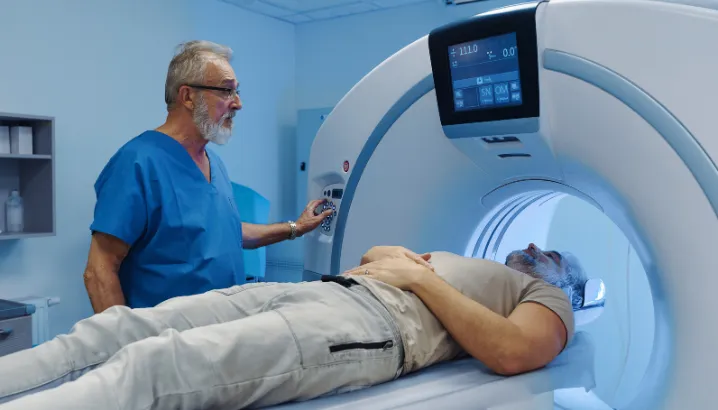
During your visit, we will review your medical history and observe how you walk. We use advanced imaging scans to confirm whether the cartilage wear is strictly limited to one compartment of your joint.
Ready to live without knee pain?
If joint stiffness is holding you back from the life you love, our orthopaedic experts are here to help. Book your knee replacement consultation in Pune today and let us create a personalised treatment plan for you.
Call us or book an appointment online
Partial vs Total Knee Replacement: What is the difference?
Understanding your surgical options can feel overwhelming. To help you make an informed decision, here is a simple comparison between the two main types of knee surgeries.
Feature | Partial Knee Replacement | Total Knee Replacement |
| Area Treated | Only the damaged compartment | The entire knee joint |
| Ligament Status | Healthy ligaments are preserved | Some ligaments may be removed |
| Incision Size | Smaller (minimally invasive) | Larger, traditional incision |
| Hospital Stay | Usually 1 to 2 days (sometimes same-day) | Typically 3 to 5 days |
| Recovery Time | 3 to 6 weeks | 6 to 12 weeks |
| Joint Feel | Feels more like a natural knee | May feel slightly mechanical |
Determining When You Should Get a Knee Replacement depends on your pain levels and how much your mobility is restricted. You can also explore the Best Knee Replacement Options to see which technology, such as robotic assistance, fits your needs.
How long does recovery take after the surgery?
One of the most encouraging aspects of this procedure is the rapid recovery timeline. Most of our patients are able to stand and walk with a supportive aid on the very same day of their surgery.
Within the first few weeks, you will work closely with a physical therapy team to rebuild the strength in your leg. We guide you through specific exercises designed to restore your flexibility and confidence safely.
By the fourth to sixth week, many people can resume driving, return to office work, and enjoy light activities like swimming or cycling. We monitor your progress closely to ensure your joint heals perfectly.
Maintaining a healthy lifestyle and following a specific Diet Plan After Knee Replacement Surgery is essential for healing.
While rare, it is important to know the signs of complications, which you can find in our guide on Infection After Knee Replacement.
How can our specialists help you move freely again?
Choosing the right medical team makes all the difference in your orthopaedic journey. We understand that deciding on surgery is a major step, and we are committed to providing you with clear, honest guidance.
As a leading Best knee replacement hospital in Pune, Lokmanya Hospitals combines advanced robotic-assisted technology with decades of surgical expertise.
This allows us to place implants with pinpoint accuracy, ensuring long-lasting comfort and stability.
We surround you with a compassionate care team, from your very first consultation right through to your final physical therapy session. Your comfort, safety, and swift return to an active life are always our highest priorities.
Moving forward with confidence
Living with limited mobility does not have to be your permanent reality. If your knee pain is isolated to one area and conservative treatments have failed, a partial replacement could be the perfect solution.
By preserving your healthy bone and ligaments, this modern procedure offers a quicker, less painful path back to the activities you cherish.
Reach out to our team at Lokmanya Hospitals to discover how we can help you reclaim your mobility and quality of life.
Frequently Asked Questions
Can I run or play sports after recovering from surgery?
While high-impact activities like marathon running are generally discouraged to protect the implant, you can absolutely return to low-impact sports. Activities like golf, cycling, brisk walking, and swimming are highly encouraged once your surgeon clears you.
Am I too old to be considered for this procedure?
There is no strict age limit for this surgery. Eligibility is based entirely on your overall health, bone quality, and the specific pattern of your arthritis, rather than how many birthdays you have celebrated.
Will I eventually need a total knee replacement anyway?
Not necessarily. When performed on carefully selected patients, these implants can last 15 to 20 years. However, if arthritis naturally develops in the untreated parts of your knee later in life, a revision to a total joint replacement is possible.
Is the surgery very painful?
All surgeries involve some discomfort, but this procedure is much less painful than traditional joint surgery. We use advanced nerve blocks and tailored pain management programmes to keep you comfortable during the vital early stages of healing.
How do I know if my ligaments are healthy enough?
During your physical examination, your orthopaedic doctor will gently stress your knee to check its stability. We also use MRI scans or detailed X-rays to visually confirm that your anterior cruciate ligament (ACL) and other supporting structures are completely intact.