Do Compression Stockings Really Treat Varicose Veins or Just Hide the Symptoms?
Category: Blogs
 Tue Jun 23 2026


Your doctor prescribed compression stockings. Your legs feel better when you wear them. But take them off in the evening and the aching, the heaviness, the swelling it all comes back.
So the question is entirely fair: are these stockings actually treating anything, or are they just a temporary fix?
The honest answer is both and understanding which is which will help you make far better decisions about your vein health.
Patients seeking compression stockings for varicose veins in PCMC frequently arrive at Lokmanya Hospitals, a trusted multispecialty hospital with an experienced vascular team, unsure whether stockings are a long-term solution or a placeholder until something more definitive is needed. This article gives you the complete, clinically accurate picture.
Key Takeaways :
- Exactly what compression stockings do and do not do to varicose veins
- Why compression manages venous disease but cannot reverse valve damage
- The compression levels that exist and which one you actually need
- Critical safety situations where compression stockings should not be worn
- When compression is genuinely sufficient and when treatment is the right step
What Do Compression Stockings Actually Do to Your Veins?
Compression stockings work but they work in a specific, mechanical way that is worth understanding properly rather than assuming.
- The Mechanical Action of Graduated Compression
Graduated compression stockings apply the highest pressure at the ankle and progressively less pressure as they move up the leg. This gradient is not accidental it is engineered to mimic and assist the body's natural venous return mechanism.
By squeezing the surface veins of the leg from the outside, the stocking reduces the diameter of those veins.
A narrower vein carries blood at higher velocity and lower pooling volume meaning blood moves upward more efficiently rather than sluggishly pooling under gravity.
The word graduated is the clinically important one here. A stocking that applies uniform pressure throughout the leg like a tight sock does not achieve this effect. Only properly manufactured graduated compression achieves the therapeutic gradient that makes a clinical difference.
- How Compression Assists the Calf Muscle Pump
The calf muscles are the primary engine for pushing venous blood back up toward the heart. When you walk, the calf contracts and squeezes the deep veins, propelling blood upward.
Compression stockings augment this pumping action even when you are sitting still, the external pressure on the surface veins continuously supports venous return.
The type of movement that most actively engages this pump — and which exercises help or harm varicose veins — is covered in detail in our guide on exercise and varicose veins: what helps and what harms, which is a useful companion read for patients managing their condition with both compression and activity.
This is why patients who stand or sit for long hours teachers, IT professionals, healthcare workers experience the most dramatic symptom relief from compression. Their calf pump is underutilised by their occupation, and compression partially compensates for that deficit.
- What Changes While the Stocking Is On And What Does Not
This is the part most patients are not told clearly. While the stocking is being worn, venous pooling is reduced, swelling is controlled, venous pressure is lowered, and symptoms like heaviness and aching improve measurably.
This is also why the return of symptoms each evening once stockings are removed after a long day follows such a predictable pattern.
The physiological reason pain and heaviness peak by end of day, and what is driving that cycle beyond just stocking removal, is explained in detail in our article on why varicose veins hurt more at night.
What does not change is the underlying structural problem. The vein valve that has already failed does not repair itself because a stocking is providing external support.
The vein wall that has already dilated does not return to its original diameter permanently. The stocking is doing the job the valve can no longer do but only for as long as it is worn. Remove the stocking, and the failed valve resumes causing the same problem.
Do Compression Stockings Treat the Cause of Varicose Veins or Just the Symptoms?
The direct answer: compression stockings manage symptoms and slow disease progression they do not treat the underlying cause.
- The Honest Clinical Answer
Varicose veins are caused by chronic venous insufficiency the failure of vein valves to prevent blood from flowing backward.
No external compression device repairs a damaged valve. The stocking substitutes for the valve's function from the outside; it does not restore the valve's function from the inside.
This is not a criticism of compression therapy. It is a straightforward description of its mechanism.
Managing a progressive disease is genuinely valuable particularly when the alternative is allowing venous hypertension to build unchecked, accelerating damage to tissue, skin, and adjacent veins.
- What the Research Says About Compression and Disease Progression
Research in venous disease management consistently shows that regular compression stocking use reduces symptom severity, decreases ankle oedema, improves quality of life scores, and slows the measurable progression of chronic venous insufficiency compared to no compression.
Understanding where a patient sits on the disease progression scale — from early C2 varicose veins to advanced C4 skin changes — helps determine how much work compression alone can realistically do.
Our guide on varicose vein symptoms, stages, and early warning signs explains the full CEAP staging system clearly, which is useful context for any patient trying to understand their situation.
A Cochrane Review examining compression therapy for venous leg ulcers the most advanced complication of untreated venous disease found that compression significantly improved healing rates.
This tells us that even at severe disease stages, compression produces meaningful clinical benefit. It does not reverse the disease, but it actively restrains its worst consequences.
- Why Doctors Still Prescribe Them Despite This Limitation
Because they work for what they are designed to do. Compression stockings are the most evidence-based conservative treatment available for symptomatic varicose veins and for patients who are not yet ready for or suitable for procedural treatment, they provide genuine daily benefit.
They also serve a role after procedural treatment helping consolidate results, reduce post-procedure swelling, and protect treated veins during the healing period. Their value is real. Their limitation is simply that they are not a cure.
What Compression Level Do You Actually Need And Does It Matter?
Yes it matters significantly, and most patients are never given a clear explanation of this.
- Understanding mmHg The Pressure Measurement Explained
Compression is measured in millimetres of mercury (mmHg) the same unit used for blood pressure. The number tells you how much pressure the stocking applies at the ankle, which is where compression is highest in a graduated design.
Higher mmHg means more compression. But more is not always better the correct level depends on the severity of your venous disease and any coexisting conditions.
- The Compression Classes Explained in Plain Language
Class I stockings (15–21 mmHg) are suitable for mild symptoms mild leg heaviness, early varicosities, and prevention during long travel or pregnancy. These are available without prescription and cause minimal discomfort.
Class II stockings (23–32 mmHg) are the most commonly prescribed level for established varicose veins, moderate chronic venous insufficiency, and post-procedural recovery. These require more effort to put on and should ideally be prescribed based on clinical assessment.
Class III stockings (34–46 mmHg) are used for severe venous disease significant oedema, lipodermatosclerosis, and venous ulcer management. These are prescription-grade and require careful monitoring, particularly in elderly patients or those with any arterial insufficiency.
- Why Buying the Wrong Level at a Pharmacy Creates Problems
Purchasing a compression stocking without clinical guidance is a meaningful risk not a minor one.
A patient with undiagnosed peripheral arterial disease who buys a Class II stocking at a pharmacy and wears it daily could cause significant tissue damage to the lower leg, because compression in the presence of poor arterial supply restricts blood flow to the skin and can precipitate ulceration.
Equally, a patient with significant venous disease who buys a mild Class I stocking will experience some comfort but inadequate therapeutic benefit and may falsely conclude that compression does not work for them.
Are There Patients for Whom Compression Stockings Are Not Safe?
Yes and this safety point is almost entirely absent from patient-facing content on compression therapy.
- Peripheral Arterial Disease The Critical Contraindication
Peripheral arterial disease (PAD) is a condition where the arteries supplying blood to the legs are narrowed, reducing circulation to the limb. In a patient with PAD, the legs are already receiving insufficient arterial blood flow.
Applying external compression to such a leg reduces perfusion pressure further potentially causing ischaemic damage to the skin and underlying tissue.
PAD and venous disease frequently coexist in older patients, making clinical assessment before prescribing compression an absolute requirement.
An ankle-brachial pressure index (ABPI) measurement a simple, non-invasive test should be performed before compression therapy is initiated in any patient over 60 or with diabetes, cardiovascular disease, or leg ulceration.
- Diabetic Patients and Pressure-Related Skin Risk
Patients with diabetes, particularly those with peripheral neuropathy nerve damage that reduces sensation in the feet and legs are at risk of pressure-related skin injury from compression stockings without realising it.
Because sensation is reduced, they may not feel a fold in the stocking, an incorrectly applied band, or developing pressure on a bony prominence.
Diabetic patients should only use compression stockings under specialist supervision with regular skin checks to ensure no pressure injury is developing.
How Should Compression Stockings Be Used Correctly for Maximum Benefit?
Most patients wear compression stockings incorrectly and the difference in outcome is clinically significant.
- The Morning Rule Why Timing Matters Physiologically
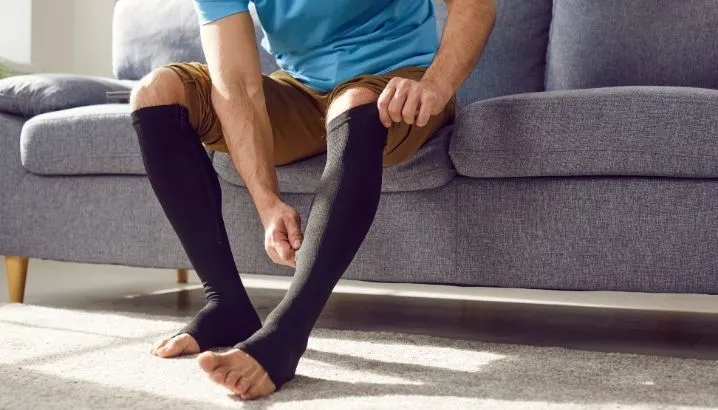
Compression stockings must be put on first thing in the morning, before standing up from bed. This is not a preference it is based on physiology.
When you lie down overnight, the venous pooling in your legs drains passively. Your veins are at their least distended in the morning. Applying compression at this point means you are supporting veins that are in their best possible state less stretched, less engorged, and more responsive to the graduated pressure.
If you stand up, walk around for twenty minutes, and then try to put on your stockings, the veins have already re-filled with pooled blood.
The stocking is now working against maximum venous distension, providing less effective support and being considerably harder to apply.
- How Long to Wear Them and When to Remove Them
Wear compression stockings throughout the day from the moment you get up until you lie down in the evening. There is no benefit to wearing them while horizontal, because venous return is not gravity-dependent when lying flat.
Remove them in the evening, allow the skin to breathe, and inspect the skin below the knee for any signs of pressure, redness, or irritation. This daily check is particularly important for diabetic and elderly patients.
- How to Tell If Your Stockings Have Lost Their Compression
Compression stockings lose their therapeutic elasticity over time typically after four to six months of regular daily use.
A stocking that feels loose, rolls down at the top, or does not create any visible or felt compression at the ankle has lost its effectiveness and is providing little therapeutic benefit.
Hold the stocking up and stretch it it should spring back firmly and evenly. If it feels slack or the elastic gives without resistance, it needs replacing.
Wearing an expired stocking provides false reassurance without clinical benefit a point almost no patient is ever told.
When Is Compression Not Enough and Treatment Is the Right Answer?
Compression manages the condition. It does not resolve it. There are clear signals that indicate a patient has moved beyond what compression alone can adequately control.
- Signs That Compression Is Containing But Not Controlling the Disease
If symptoms are worsening despite consistent stocking use, if ankle swelling is present even in the morning before activity begins, if skin pigmentation or thickening is developing around the ankle, or if new varicose veins are appearing despite compliance with compression these are clinical indicators that the underlying venous insufficiency is progressing beyond what conservative management can contain.
At this point, compression becomes a supportive measure rather than the primary treatment. A duplex ultrasound assessment to map the venous disease is the appropriate next step.
- What Modern Treatment Offers That Compression Cannot
Endovenous laser ablation, radiofrequency ablation, and foam sclerotherapy close the source of venous reflux from within permanently. They address the failed valve's effect by eliminating the vein driving the backflow, rather than compensating for it externally.
Recovery is measured in days. Procedures are performed as outpatient appointments. And the improvement in symptoms including the reduced need for compression afterward is sustained rather than conditional on wearing a garment every day for the rest of your life.
For a full overview of which procedure is appropriate at which disease stage, the varicose vein treatment options at Lokmanya Hospitals cover everything from EVLT and radiofrequency ablation to VenaSeal and foam sclerotherapy in one place.
If you are in Pimpri Chinchwad or Pune and have been managing varicose veins with compression stockings for a year or more particularly if symptoms are not fully controlled or your disease appears to be progressing a vascular consultation is the right next step.
The specialist team at Lokmanya Hospitals provides duplex-guided assessment and a clear, honest recommendation about whether compression remains appropriate or whether varicose veins compression therapy in Pimpri Chinchwad has reached its limits for your specific situation. Visit lokmanyahospitals.com to book your consultation.
Final Thoughts
Compression stockings are genuinely useful for symptom management, disease slowing, post-procedure recovery, and prevention in high-risk situations. They are not a placebo, and dismissing them as "just hiding symptoms" misses the real clinical value they provide.
But they are also not a cure. A damaged vein valve does not repair itself because a stocking is compensating for it externally.
Compression buys time, reduces harm, and improves daily life and for some patients, that is exactly what is needed.
For others, it is a management tool that has reached its limits, and procedural treatment is the appropriate progression.
Knowing which situation you are in requires an honest clinical assessment not a guess based on how your legs feel on a given day.
That assessment is available, the treatment options are minimally invasive, and the outcomes from treating varicose veins early are consistently better than managing them indefinitely with compression alone.
Frequently Asked Questions
What happens to varicose veins if I stop wearing compression stockings suddenly?
When compression stockings are removed, the external support they provide disappears and venous pooling resumes. Symptoms leg heaviness, aching, and swelling typically return within hours, particularly after a day of standing or sitting. Stopping suddenly does not damage the veins further, but it removes the protective effect immediately, which is why consistent daily use matters.
Can I wear compression stockings during exercise?
Yes wearing compression stockings during exercise, particularly walking or cycling, actively enhances the benefit of both the stocking and the exercise. Compression augments the calf muscle pump effect during movement, improving venous return more than either intervention alone. Ensure the stocking fits correctly and does not restrict knee flexion during exercise.
Are compression stockings in India covered under health insurance?
Medical-grade compression stockings prescribed for documented venous disease are covered under some health insurance policies in India, particularly when part of a post-surgical care plan or chronic disease management protocol. Coverage varies significantly between insurers and policy types. A formal prescription from a vascular specialist with a documented diagnosis strengthens any insurance claim for compression therapy costs.
Is there a difference between compression stockings sold at pharmacies and those prescribed by doctors?
Yes a meaningful one. Medically prescribed compression stockings are manufactured to precise compression standards, tested for consistent graduated pressure across the garment, and available in the correct compression class for the patient's condition. Many pharmacy stockings are not manufactured to the same standards, may not deliver true graduated compression, and are typically only available in mild compression levels. For therapeutic use in established venous disease, prescribed medical-grade stockings are significantly more effective.
Can compression stockings be worn during sleep for extra benefit?
No compression stockings should not be worn during sleep. When lying down, venous return is not gravity-dependent and occurs efficiently without assistance. Wearing compression while horizontal provides no additional benefit and can cause unnecessary pressure on the skin and underlying tissue during extended immobility. The therapeutic window for compression is during waking, upright activity not during rest.

Dr. Pranjal Melge
- MBBS, DNB (General Surgery), DrNB (Vascular Surgery)
Consultant Vascular & Endovascular Surgeon