Varicose Veins vs Spider Veins: What Is the Real Difference And Does It Change Your Treatment?
Category: Blogs
 Thu Jun 18 2026


They both appear on the legs, they both involve visible veins, and they both cause concern but varicose veins and spider veins are not the same condition, do not carry the same medical risk, and do not always need the same treatment.
Getting this distinction right matters. Patients across Pune who come in worried about one often have the other or both simultaneously.
At Lokmanya Hospitals (lokmanyahospitals.com), a trusted multispecialty hospital offering spider veins and varicose veins treatment in Pune, the first step in every vein consultation is clarifying exactly what the patient is dealing with before discussing any treatment path.
This article gives you that clarity.
Key Takeaways:
- The clear clinical difference between varicose veins and spider veins
- Why both conditions share a common cause but differ in severity
- When spider veins are a cosmetic concern vs a medical one
- What treatments are available for each and why they differ
- Whether spider veins can progress into varicose veins over time
What Exactly Are Varicose Veins and Spider Veins Are They the Same Thing?
They are related conditions, but they are not the same. The distinction lies in size, depth, and medical significance.
Defining Varicose Veins
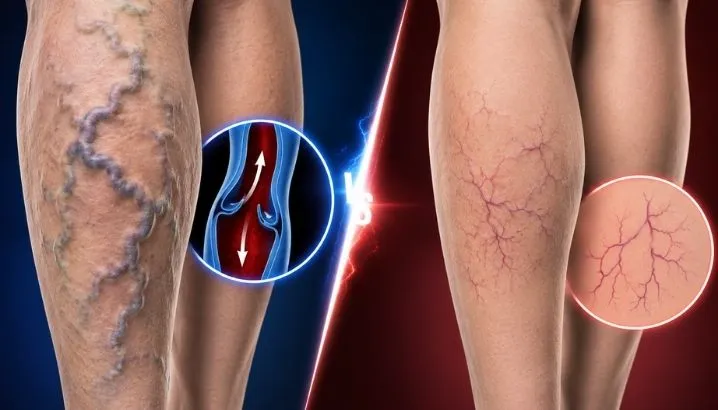
Varicose veins are enlarged, twisted veins that bulge visibly above the skin surface. They are typically 3mm or more in diameter and most commonly appear on the thighs, calves, and backs of the knees.
They are not just a surface problem. Varicose veins develop in the superficial venous system the network of veins that runs just beneath the skin and they are caused by vein valve dysfunction, where the one-way valves inside the vein stop working properly. Blood pools in the vein under increasing pressure, causing it to stretch and bulge outward.
The result is often visible as a rope-like, blue or dark purple structure under the skin and it is frequently accompanied by aching, heaviness, swelling, and fatigue in the affected leg.
Defining Spider Veins
Spider veins medically called telangiectasia are tiny, dilated blood vessels that appear as red, blue, or purple web-like patterns directly on the skin surface. They are usually less than 1mm in diameter and do not bulge above the skin.
They get their name from the way they spread outward in thin lines from a central point resembling a spider's web or fine branching pattern. They appear most commonly on the legs and face and are generally flat to the touch.
The Middle Ground Most Articles Ignore Reticular Veins
There is a third category that most patient-facing content never mentions: reticular veins. These are blue-green veins ranging from 1mm to 3mm that sit between spider veins and varicose veins in terms of size and depth.
Reticular veins often feed spider veins acting as the pressure source that causes smaller vessels to dilate.
Treating spider veins without addressing the reticular veins feeding them is a common reason spider veins recur after sclerotherapy. A thorough vascular assessment should identify all three types, not just what is visible on the surface.
Where Each Type Typically Appears?
Varicose veins concentrate along the inner thigh, calf, and behind the knee following the path of the great and small saphenous veins. Spider veins appear more diffusely across the outer thigh, lower leg, and ankle and commonly on the face, particularly around the nose and cheeks.
What Causes Each Condition And Is the Root Cause the Same?
At the deepest level, yes both conditions involve a failure of the venous system to return blood efficiently to the heart. But the specific mechanisms differ.
Vein Valve Dysfunction The Shared Foundation
Every vein in the body contains small one-way valves that open to allow blood to flow upward and close to prevent it from falling back down.
When these valves weaken or fail, blood flows backward a condition called venous reflux and pressure builds in the vein wall.
This increased pressure, known as venous hypertension, is the root cause driving both conditions. The difference is where that pressure manifests in deeper, larger vessels for varicose veins, or in the finest surface capillaries for spider veins.
Why Varicose Veins Develop From Deeper Pressure?
Varicose veins typically originate from incompetence in the larger truncal veins most commonly the great saphenous vein running along the inner leg.
When the valves in this larger vein fail, the pressure cascades downward into smaller branches, causing them to dilate progressively.
This is a structural, progressive problem. Left unaddressed, the pressure continues to build, and the veins continue to enlarge.
Why Spider Veins Form Closer to the Skin?
Spider veins form when pressure either from deeper venous insufficiency or from localised capillary fragility forces the smallest surface vessels to dilate. Hormonal changes are a particularly significant trigger, which explains why spider veins are far more common in women.
Oestrogen and progesterone both affect the elasticity of vein walls. During pregnancy, menstrual cycles, and hormonal therapy, fluctuating levels of these hormones cause vein walls to relax and dilate more easily creating the conditions for spider vein development.
Genetics and Occupational Risk
A family history of either condition is the strongest single predictor of developing both. Jobs requiring prolonged standing teachers, nurses, retail staff, and factory workers in Pimpri Chinchwad accelerate vein disease by keeping venous pressure elevated for long hours daily.
How Serious Is Each Condition When Does It Go Beyond Appearance?
This is the question that matters most to patients, and it deserves a direct answer.
Spider Veins Mostly Cosmetic, But Not Always
In the majority of cases, spider veins are a cosmetic concern. They cause no physical symptoms and carry no medical risk. However, this is not universally true.
When spider veins appear in large clusters, particularly around the inner ankle a pattern called corona phlebectatica they can be a surface indicator of significant underlying venous hypertension. Research in vascular medicine has established this ankle pattern as a clinical warning sign warranting deeper investigation, not just cosmetic treatment.
Varicose Veins A Progressive Medical Condition
Varicose veins are a medical condition, not purely a cosmetic one. Without management, they progress through recognised stages from visible veins with mild aching, to significant swelling and skin changes, to skin discolouration (lipodermatosclerosis), and ultimately to venous ulcers near the ankle that are difficult to heal.
Our dedicated guide on varicose vein symptoms, stages, and early warning signs explains the full CEAP classification and what each stage means for your treatment options.
Most patients presenting with visible varicose veins are already at C2 or C3. Without treatment, progression is the norm, not the exception.
When Varicose Veins Become Emergencies
Superficial thrombophlebitis clotting inside a varicose vein causes sudden pain, redness, and hardening along the vein and requires prompt medical evaluation.
Bleeding from a varicose vein which can occur spontaneously or after minor trauma is a medical emergency requiring immediate pressure and urgent hospital attention.
For a full clinical breakdown of how clots form in varicose veins, how to distinguish a superficial clot from a DVT, and when to seek emergency care, our detailed guide on whether varicose veins can cause a blood clot covers the topic in full.
How Are These Two Conditions Properly Diagnosed?
Correct diagnosis determines correct treatment and visual inspection alone is not always sufficient.
What a Doctor Assesses Clinically?
A vascular specialist examines the distribution, size, and character of visible veins, checks for swelling and skin changes, and asks about symptoms.
The presence of leg aching, heaviness, or swelling alongside spider veins immediately raises the suspicion of underlying venous insufficiency and changes the investigation needed.
Duplex Ultrasound Why It Changes Everything
A duplex ultrasound scan maps the venous system beneath the skin identifying which valves are incompetent, where reflux is occurring, and whether varicose veins visible on the surface are being fed by deeper insufficiency.
This scan is essential for all varicose vein patients. It is also sometimes necessary for spider vein patients particularly when symptoms are present, when spider veins are extensive, or when they recur rapidly after previous treatment.
Treating the surface without knowing what is happening underneath leads to poor outcomes and early recurrence.
What Treatment Options Exist And Are They Different for Each?
Yes treatments differ significantly between the two conditions, though there is some overlap.
Sclerotherapy for Spider Veins
Sclerotherapy is the gold standard for spider veins. A fine needle is used to inject a chemical solution directly into the affected vessel, causing it to collapse and gradually fade.
Multiple sessions are typically needed, and results develop over several weeks as the body absorbs the treated vessels.
For reticular veins feeding spider veins, a slightly stronger concentration is used and treating these feeder vessels is what prevents rapid recurrence.
Laser Treatment for Surface Spider Veins
Surface laser therapy directs light energy at the pigmented vessel, heating it selectively until it collapses. It is particularly effective for facial spider veins and very fine leg vessels too small for needle injection. It requires no needles and leaves no marks, though multiple sessions are standard.
Endovenous Ablation for Varicose Veins
Varicose veins require a more definitive treatment approach. Endovenous laser ablation and radiofrequency ablation use thermal energy delivered through a thin catheter to close the incompetent truncal vein from within. This addresses the pressure source not just the visible vein and produces durable results with minimal recovery time.
For a full overview of all available procedures from EVLT and VenaSeal to sclerotherapy and phlebectomy the complete guide to varicose vein treatment options at Lokmanya Hospitals outlines what each procedure involves and which presentations it is best suited for.
If you are in Pune or Pimpri Chinchwad and uncertain whether what you have are spider veins, varicose veins, or something in between, a proper duplex-guided vascular assessment is the right starting point. The vascular team at Lokmanya Hospitals provides comprehensive evaluation and tailored spider veins and varicose veins treatment in Pune for both conditions. Visit lokmanyahospitals.com to book your consultation knowing exactly what you are dealing with is the most important first step.
Can Spider Veins Turn Into Varicose Veins Over Time?
This is one of the most common questions patients ask and the answer is clinically important.
The Relationship Between the Two Conditions
Spider veins do not directly transform into varicose veins. They are different types of vessels spider veins are capillaries and tiny venules, while varicose veins are larger superficial veins. One does not become the other structurally.
However, both conditions can coexist and worsen together when the underlying driver venous hypertension is present and untreated.
A patient with spider veins today who also has undiagnosed valve incompetence in a larger vein may develop varicose veins over the following years not because the spider veins evolved, but because the same underlying pressure is acting on progressively larger vessels.
What This Means for Treatment Timing?
Treating spider veins cosmetically while ignoring underlying venous insufficiency is incomplete care. The spider veins will recur, the underlying disease will progress, and the patient will face a more significant problem later.
This same principle applies to varicose vein treatment itself even properly treated veins can return when the underlying chronic venous disease is left unmanaged, a pattern explained fully in our article on why varicose veins come back after treatment and what patients can do about it.
This is why a duplex ultrasound is sometimes recommended even for patients who present with what appears to be a straightforward cosmetic spider vein concern. It rules out a deeper problem and if one is found, treating it changes the entire treatment plan.
Final Thoughts
Varicose veins and spider veins are related but distinct conditions. Spider veins are usually cosmetic; varicose veins are a progressive medical condition that warrants proper evaluation and timely treatment.
Both stem from the same underlying mechanism venous pressure and valve dysfunction and both are treatable with modern minimally invasive techniques. The key is accurate diagnosis first, so the right treatment is applied to the right problem.
Do not assume that because your veins look small, they do not matter. And do not assume that because your veins look large, the situation is beyond help.
With the right assessment and the right care, both conditions are very manageable and the earlier you address them, the better your outcome.
Frequently Asked Questions
Are spider veins on the face the same as spider veins on the legs?
They are the same type of vessel dilated capillaries and tiny venules but the causes differ slightly. Facial spider veins are more commonly triggered by sun exposure, rosacea, and temperature changes, while leg spider veins are more often related to venous pressure, hormones, and prolonged standing. Treatment approaches also differ facial veins respond better to laser, while leg veins respond well to sclerotherapy.
Is varicose vein treatment covered under health insurance in India?
Varicose vein treatment is generally covered under health insurance when the condition is medically documented as symptomatic meaning it causes pain, swelling, skin changes, or ulceration. Purely cosmetic procedures, including spider vein sclerotherapy, are typically not covered. A formal diagnosis and clinical documentation from a vascular specialist strengthen insurance claims significantly.
Can men get spider veins, or is this mainly a women's condition?
Men do develop spider veins, though less frequently than women. The lower prevalence in men is largely explained by the absence of hormonal fluctuations related to menstrual cycles and pregnancy. Men who stand for long hours, have a family history of vein disease, or have experienced leg injuries are at meaningful risk of both spider veins and varicose veins.
Do compression stockings help spider veins, or only varicose veins?
Compression stockings are primarily beneficial for varicose veins and underlying venous insufficiency. For spider veins in isolation, without significant underlying venous hypertension, compression has limited direct effect on the spider veins themselves. However, if spider veins are accompanied by any degree of venous insufficiency, even mild compression helps slow disease progression.
After spider vein treatment, how long before results are visible?
After sclerotherapy, treated spider veins gradually fade over four to eight weeks as the body absorbs the collapsed vessels. Some veins may appear darker initially before fading; this is a normal part of the healing process, not a sign that treatment failed. Full results from a session are typically assessed at the six to eight week mark before deciding whether additional sessions are needed.