Can You Preserve Your Natural Knee Without Replacement?
Category: Orthopedics
 Thu Sep 17 2026


When patients ask me whether they can avoid knee replacement, my answer is always based on the condition of their knee, not just their pain level.
Dr. Nikhil Lakhate, as an orthopedic specialist at Lokmanya Hospitals, Pune, I first look at the cause of the problem, the amount of cartilage damage, knee alignment, symptoms and how much the condition affects daily life.
In some people, the natural knee can be preserved for many years with the right treatment plan. In advanced arthritis, however, replacement may eventually be the safer and more effective option.
Key Takeaways
- Not every patient with knee arthritis needs immediate joint replacement.
- Exercise, physiotherapy, weight management and medicines can help control symptoms.
- The treatment depends on the extent and location of cartilage damage.
- Some patients may benefit from selected joint-preserving procedures.
- The goal is to preserve the natural knee when it is medically reasonable, not to delay necessary treatment.
What Does It Mean to Preserve Your Natural Knee?
Preserving your natural knee means trying to maintain your own knee joint and its function instead of moving directly to joint replacement.
The approach can include lifestyle changes, medicines, physiotherapy, injections and, in selected patients, procedures designed to protect or redistribute load across the knee.
I often tell my patients that the aim isn't simply to avoid an operation. The real aim is to maintain a comfortable, functional knee for as long as it is safely possible.
Can Knee Arthritis Be Treated Without Surgery?
Yes, knee arthritis treatment can often begin without surgery, particularly when symptoms are mild or moderate.
Treatment may include:
- Physiotherapy
- Quadriceps strengthening
- Low-impact exercise
- Weight management
- Activity modification
- Pain-relieving medicines when appropriate
- Injections for selected patients
- Walking aids or braces in certain situations
The American Academy of Orthopaedic Surgeons recommends exercise, weight management where appropriate, topical or oral anti-inflammatory medicines in suitable patients and other non-surgical approaches for knee osteoarthritis.
The right combination depends on your age, activity level, medical conditions, knee structure and severity of arthritis.
How Does Knee Osteoarthritis Affect the Natural Knee?
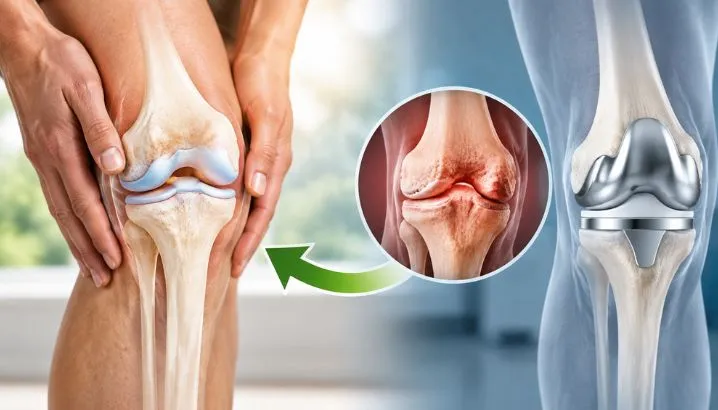
Knee osteoarthritis gradually affects the tissues that allow the joint to move smoothly. The cartilage covering the ends of the bones can become thinner or damaged.
As the condition progresses, you may develop:
- Knee pain while walking
- Pain while climbing stairs
- Stiffness after sitting
- Difficulty squatting
- Swelling
- Reduced knee movement
- Pain during prolonged standing
- Difficulty with everyday activities
However, pain does not always tell us exactly how much structural damage is present.
Some people have considerable changes on an X-ray but manageable symptoms. Others have substantial pain despite less advanced-looking changes.
That is why I assess both your symptoms and the physical condition of your knee.
Can Exercise Help Save the Natural Knee?
Yes. Appropriate exercise can play an important role in joint preservation.
Strong muscles around the knee, particularly the quadriceps, help support the joint and improve function. Low-impact activities such as walking, cycling and swimming can be useful for many people with knee osteoarthritis.
I usually recommend exercises based on what your knee can tolerate rather than asking you to stop moving completely.
Avoiding movement because of pain can lead to muscle weakness and reduced function.
At the same time, not every exercise is suitable for every knee. High-impact activity, deep squatting or repetitive movements may need to be modified depending on your condition.
Can Weight Management Reduce Knee Stress?
If you are overweight, weight management can be an important part of protecting the knee.
Extra body weight increases the load placed on the knee during everyday activities. Even when weight loss doesn't completely remove arthritis, it can make movement easier and may reduce symptoms.
I don't recommend weight loss simply because of the number on the weighing scale. I look at it as part of a broader plan to reduce stress on the knee and improve overall mobility.
What Are the Non-Surgical Knee Replacement Alternatives?
There isn't one treatment that works for everyone. Common knee replacement alternatives include:
Physiotherapy
A structured physiotherapy program can improve muscle strength, flexibility, balance and knee function.
Medicines
Depending on your health and other medicines, your doctor may recommend topical or oral anti-inflammatory medicines or other pain-relieving options. These aren't suitable for everyone, so they should be used under medical guidance.
Injections
Some patients may benefit from corticosteroid injections for short-term symptom relief. Other injections, including hyaluronic acid or platelet-rich plasma, have more variable evidence and should not be presented as guaranteed cartilage-restoring treatments.
Braces or Walking Aids
In selected patients, a brace, cane or other walking aid can reduce stress on the painful part of the knee and make movement easier.
Activity Modification
You don't necessarily have to stop being active. Sometimes changing the type, duration or intensity of an activity is enough to reduce knee irritation.
Can Joint-Preserving Surgery Help?
In selected patients, surgery does not always mean replacing the entire knee.
If arthritis is mainly affecting one part of the knee, a partial knee replacement may sometimes be considered. In other situations, particularly when abnormal knee alignment is contributing to uneven loading, an osteotomy may be appropriate.
What Is Knee Surgery? covers the fuller range of surgical options, from ligament repair through partial and total replacement, if you want to understand where these joint-preserving procedures sit relative to the alternatives.
These procedures aren't suitable for everyone.
The decision depends on factors such as:
- Location of arthritis
- Knee alignment
- Ligament condition
- Range of movement
- Age and activity level
- Extent of cartilage damage
- Overall knee function
Joint-preserving surgery should be considered only after a proper assessment of the knee.
How Do I Know If My Natural Knee Can Still Be Preserved?
This is one of the most important questions I discuss with patients.
I look at:
- Your symptoms
- X-rays and, when required, other imaging
- The location and extent of cartilage damage
- Knee alignment
- Ligament stability
- Range of movement
- Muscle strength
- Your ability to perform daily activities
The same X-ray finding can mean different things for different people.
If your symptoms are manageable and the knee still functions reasonably well, conservative treatment may be appropriate.
If pain and stiffness are severe, walking becomes difficult and non-surgical treatment no longer provides meaningful relief, we need to discuss surgical options honestly.
Whether your knee can still be preserved isn't something you can determine from an X-ray alone — it needs a proper hands-on assessment. Book an Appointment with Dr. Nikhil Lakhate at Lokmanya Hospitals, Pune, or Call Now to get a clear answer on where your knee actually stands.
Can Knee Replacement Be Avoided Permanently?
Not always.
This is where I prefer to be straightforward with my patients. There is no exercise, injection or supplement that can guarantee that a severely damaged arthritic knee will never need replacement.
Some people can manage their condition for years without replacement. Others eventually reach a stage where continuing to delay surgery only prolongs pain and limits daily activities.
The decision should be based on your symptoms, function and response to treatment rather than fear of surgery alone.
Can Damaged Knee Cartilage Grow Back Naturally?
In most cases of established osteoarthritis, you should not expect damaged cartilage to simply grow back to its original condition naturally.
This is why I am cautious when patients are promised that a particular supplement, exercise or injection will completely regenerate damaged cartilage.
Some treatments can reduce pain, improve movement and help you function better, but that is different from rebuilding normal cartilage.
When Is Knee Replacement Actually Necessary?
Knee replacement may be considered when:
- Pain is persistent or severe
- Walking and everyday activities become difficult
- Sleep or quality of life is affected
- Knee stiffness substantially limits movement
- Non-surgical treatments no longer provide adequate relief
- The structural damage is advanced
NICE guidance recommends considering joint replacement referral when symptoms substantially affect quality of life and non-surgical management has been ineffective or unsuitable.
You can read the full NICE guideline on osteoarthritis diagnosis and management if you want the complete referral criteria and evidence behind this recommendation.
If you're at the stage where replacement is genuinely on the table, Best Knee Replacement Options: Total, Partial & Robotic walks through what the actual procedure choices look like once conservative treatment has been exhausted.
What Is the Best Approach for Knee Pain Treatment in Pune?
If you're looking for knee pain treatment in Pune, start with a proper diagnosis rather than choosing a treatment based only on advertisements or online claims.
Your knee pain may come from osteoarthritis, a meniscus problem, ligament injury, inflammation, alignment issues or another condition. The treatment can be completely different for each.
At Lokmanya Hospitals, Pune, I focus on identifying the actual cause and then deciding whether your knee is better managed with rehabilitation, medication, injections, joint-preserving treatment or replacement.
What Can You Do Now to Protect Your Natural Knee?
If you have early or moderate knee symptoms, don't wait until walking becomes extremely difficult.
You can start by:
- Maintaining a healthy body weight
- Staying physically active within your limits
- Strengthening the muscles around the knee
- Choosing low-impact exercise
- Avoiding unnecessary repetitive stress
- Getting persistent pain evaluated
- Following a structured physiotherapy program when advised
The earlier we understand what is happening inside the knee, the more options we may have to manage it effectively.
Frequently Asked Questions
1. Can exercise prevent knee replacement?
Exercise cannot guarantee that you will never need replacement, but appropriate strengthening and aerobic exercise can reduce symptoms and improve knee function.
2. How can I save my natural knee from replacement?
The best approach depends on why your knee is deteriorating. Maintaining muscle strength, managing weight, modifying activities and treating symptoms early can help preserve function in suitable patients.
3. Can knee arthritis be treated without surgery?
Yes, many patients can initially be managed with exercise, physiotherapy, weight management, medicines and selected injections. Advanced arthritis may eventually require surgery.
4. Does walking damage an arthritic knee?
Not necessarily. Walking is a low-impact activity that can be appropriate for many people with knee osteoarthritis, although the amount should match your symptoms and physical capacity.
5. Can squatting make knee arthritis worse?
Deep or repetitive squatting may aggravate symptoms in some people, especially when the knee is already painful or damaged. I recommend modifying the activity rather than assuming that every form of squatting is harmful.
6. Can a knee brace help me delay surgery?
A brace can help selected patients by reducing stress on a painful part of the knee or improving stability. It isn't a replacement for diagnosis and doesn't reverse arthritis.
7. Do knee injections rebuild damaged cartilage?
No injection should be considered a guaranteed method of rebuilding normal arthritic cartilage. Some injections may provide symptom relief, but their effectiveness varies by treatment and patient.
8. Is knee replacement the only option for severe arthritis?
Not always, but options become more limited as arthritis becomes advanced. Depending on the pattern of damage, selected patients may be considered for procedures such as partial knee replacement or osteotomy.
9. Can an X-ray alone tell me whether I need knee replacement?
No. X-rays are important, but I also consider your pain, movement, stability, walking ability and how much the knee affects your daily life.
10. What happens if I keep delaying knee replacement?
If your symptoms remain manageable, delaying surgery may be reasonable. But if pain and loss of function become substantial and other treatments no longer help, continued delay may unnecessarily reduce your quality of life.
Final Thoughts
A painful knee does not automatically mean that your natural knee has to be replaced.
The right question is not simply, "Can I avoid surgery?" It is, "What treatment will give my knee the best function and quality of life?"
For some patients, physiotherapy, strengthening, weight management and other non-surgical treatments are enough. For others, joint-preserving procedures may be appropriate. When arthritis is advanced and symptoms are seriously affecting daily life, knee replacement can be the right treatment.
My approach is to preserve the natural knee whenever it is medically reasonable, while also being honest when replacement offers a better long-term solution.
Medical Disclosure: This article is intended for general educational purposes and does not replace an individual medical consultation. Knee treatment should be decided after a clinical examination and appropriate imaging by a qualified orthopaedic specialist.

Dr. Nikhil S. Likhate
- MBBS | MNAMS | DNB | Fellowship in Revision Joint Replacement
Consultant Orthopaedic Surgeon & Joint Replacement Specialist