Wrist Pain: Is It Just a Sprain or Something More?
Category: Orthopedics
 Thu Aug 27 2026


A young athlete once came to me three weeks after falling on his outstretched hand, still convinced it was "just a sprain" because his initial X-ray looked normal.
It wasn't a sprain, it was a scaphoid fracture that had gone undetected, and those three weeks mattered.
I'm Dr. Nikhil S. Likhate, Orthopaedic Surgeon & Joint Replacement Specialist at Lokmanya Hospitals, Pune, and if you're searching for wrist pain treatment in Pune after a fall or injury, this is exactly the distinction worth understanding before you assume it's minor.
Key Takeaways
- Not all wrist injuries that feel like a sprain actually are one
- Scaphoid fractures are notoriously easy to miss, even on an initial X-ray
- Persistent pain at the base of the thumb after a fall is a specific warning sign
- A missed fracture can lead to poor healing and long-term wrist problems
- Getting the right diagnosis early changes both the treatment and the outcome significantly
Why "Just a Sprain" Is the Most Dangerous Assumption for a Wrist Injury
Sprains and certain fractures can feel almost identical in the first few days, which is exactly why assumption is risky.
- A fall onto an outstretched hand is the most common cause of both wrist sprains and wrist fractures, the mechanism of injury doesn't tell you which one you have
- Pain, swelling, and difficulty moving the wrist occur with both, there's no reliable way to distinguish them by feel alone
- Some fractures, particularly of the scaphoid bone, can initially hurt less than expected, which paradoxically makes them more likely to be dismissed as minor
- This overlap is precisely why "wait and see" is the wrong first instinct after a real fall or impact
What's Actually Happening in a Wrist Sprain?
A sprain means the ligaments holding your wrist bones together have been stretched or partially torn, not the bones themselves.
- The wrist relies on around 20 ligaments to keep its eight small carpal bones stable and properly aligned
- Mild to moderate sprains typically improve with rest, ice, and immobilization over two to six weeks
- More severe sprains, particularly involving the scapholunate ligament connecting two key wrist bones, can cause lasting instability if not properly treated
- A sprain that isn't improving after a couple of weeks is no longer behaving like a typical sprain, and that's worth acting on
What Makes a Scaphoid Fracture So Easy to Miss?
The scaphoid has a uniquely poor blood supply, and it's also genuinely difficult to see clearly on a standard X-ray.
- The scaphoid is a small bone near the base of the thumb, and it's the second most commonly fractured bone in the wrist
- Its blood supply enters mostly from one end, meaning certain fracture patterns can cut off circulation to part of the bone entirely
- Initial X-rays miss a meaningful number of scaphoid fractures, especially in the first days after injury, before the fracture line becomes visible
- This is why persistent thumb-side wrist pain after a fall deserves follow-up imaging even if the first X-ray looks clear
What Symptoms Should Make You Suspect It's More Than a Sprain?
Certain patterns point toward a fracture or ligament tear rather than a simple sprain.
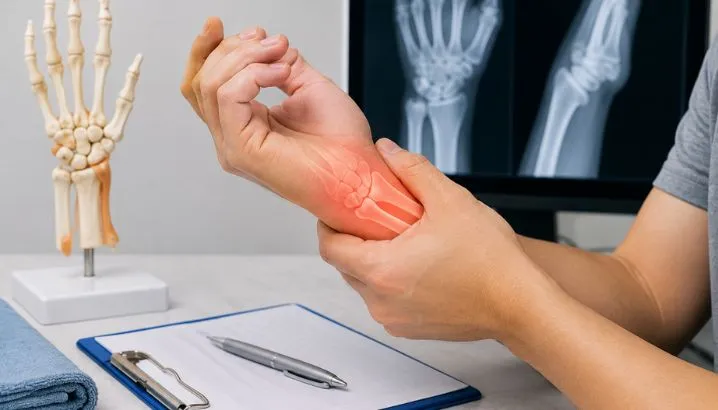
- Pain specifically at the base of the thumb, in the small hollow area of the wrist, after a fall is a classic scaphoid fracture warning sign
- Pain that doesn't meaningfully improve after two weeks of rest and immobilization suggests something beyond a typical sprain
- A popping or snapping sensation at the time of injury, or ongoing wrist instability, points more toward a significant ligament tear than a mild sprain
- Weakness in grip strength that persists well beyond the initial injury period is another signal worth mentioning to your doctor
How Is a Wrist Injury Actually Diagnosed?
Diagnosis often takes more than a single X-ray, especially when a scaphoid fracture is suspected.
- A clinical exam checking specific pressure points, including the area over the scaphoid, helps guide suspicion before any imaging
- If the first X-ray is normal but suspicion remains high, immobilization with a splint and repeat imaging after one to two weeks is standard practice
- An MRI or CT scan can detect fractures and ligament injuries that plain X-rays miss entirely
- A normal first X-ray does not rule out a fracture, this single fact is the most important thing patients often don't know
What Happens If a Fracture Gets Missed and Untreated?
Delayed diagnosis of a scaphoid fracture carries real, long-term consequences.
- Without proper treatment, the fracture may fail to heal correctly, a condition called nonunion
- This isn't a rare complication either, the NIH's clinical reference on scaphoid fractures notes nonunion rates of 14 to 50 percent in displaced fractures that go untreated, which is exactly why the initial misdiagnosis as a sprain matters so much.
- Because of the scaphoid's limited blood supply, part of the bone can lose its blood flow entirely, a serious complication called avascular necrosis
- Over time, an unstable or poorly healed wrist can lead to progressive wrist arthritis, which is far harder to treat than the original fracture
- The treatments available at that later stage are more invasive and have worse outcomes than treating the fracture early would have
What Does Proper Treatment Actually Look Like for Each?
Once the correct diagnosis is confirmed, treatment is far more targeted than generic "rest and see."
- A confirmed sprain typically responds well to splinting, activity modification, and physiotherapy over several weeks
- Top Exercise For Strengthening Your Hands And Wrists covers specific exercises useful once you're cleared to start rebuilding strength, whether you're recovering from a sprain or post-cast rehab.
- A non-displaced scaphoid fracture may heal with prolonged casting, while a displaced fracture usually needs surgical fixation with a small screw
- Once a fracture is confirmed and treatment begins, How To Recover From A Broken Wrist walks through what that recovery process and rehabilitation actually involves week to week.
- Significant ligament tears, particularly of the scapholunate ligament, may require surgical repair to prevent long-term instability
- Matching the treatment to the actual injury is what protects your wrist's function for years, not just the next few weeks
If you've had a fall or persistent wrist pain that isn't improving the way a typical sprain should, it's worth getting a focused evaluation rather than continuing to wait it out. I see patients for wrist and hand consultations at Lokmanya Hospitals, Pune.
Final Thoughts
Most wrist injuries after a fall genuinely are sprains, and most sprains heal well with simple, conservative care.
But the specific pattern of thumb-side pain, symptoms that don't improve as expected, or a fall significant enough to cause real impact deserves a proper look, because the one injury that mimics a sprain most convincingly, a scaphoid fracture, is also the one most likely to cause lasting problems if missed.
When in doubt, a follow-up X-ray or further imaging is a small step compared to the alternative.
Frequently Asked Questions
How do I know if my wrist is sprained or broken?
You often can't tell for certain from symptoms alone, persistent pain at the base of the thumb after a fall, or pain that doesn't improve after two weeks, both warrant an X-ray evaluation.
Can a scaphoid fracture be missed on X-ray?
Yes, initial X-rays miss a meaningful number of scaphoid fractures, especially in the first few days, which is why follow-up imaging matters if symptoms persist.
Why does my wrist still hurt weeks after a fall?
Persistent pain beyond the typical sprain recovery window suggests the injury may be more significant than initially thought and should be re-evaluated.
How long does a wrist sprain take to heal?
Mild to moderate sprains typically improve over two to six weeks with rest and appropriate immobilization, more severe sprains can take longer.
What happens if a scaphoid fracture is missed?
It can fail to heal properly, or part of the bone can lose its blood supply, both of which increase the risk of long-term wrist arthritis.
When should I get an X-ray for wrist pain?
Any wrist pain following a fall or significant impact, especially with swelling or difficulty moving the wrist, should be X-rayed promptly.
Is thumb-side wrist pain always a scaphoid fracture?
Not always, but it's a classic warning sign that specifically warrants ruling out a scaphoid fracture rather than assuming it's a simple sprain.
Can a wrist sprain cause long-term instability?
Yes, if a significant ligament like the scapholunate ligament is torn and untreated, it can lead to chronic wrist instability over time.
Do all wrist fractures need surgery?
No, many non-displaced fractures heal well with casting alone, surgery is typically reserved for displaced or unstable fractures.
Should I keep moving my wrist if it hurts after a fall?
No, immobilizing the wrist and seeking evaluation is safer than continuing normal activity until a fracture or significant ligament injury has been ruled out.

Dr. Nikhil S. Likhate
- MBBS | MNAMS | DNB | Fellowship in Revision Joint Replacement
Consultant Orthopaedic Surgeon & Joint Replacement Specialist
Previous blog