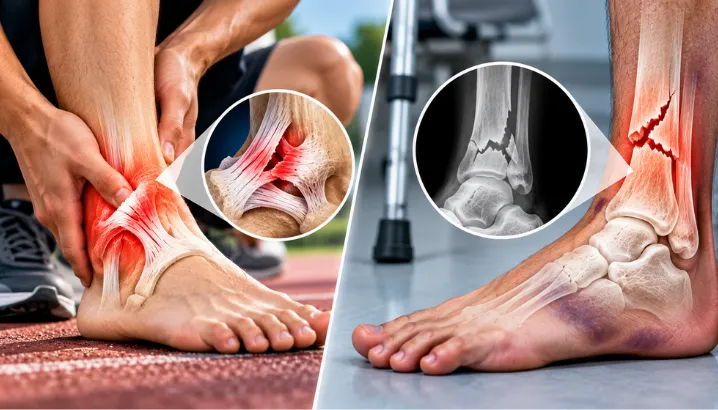
Sprain vs Fracture: How to Tell the Difference
Category: Orthopedics
 Fri Oct 23 2026


A twisted ankle, fall, or sports injury can leave you wondering, “Is it just a sprain, or is something broken?” A sprain damages a ligament, while a fracture is a crack or break in a bone, but the symptoms can overlap so much that you can't always tell the difference at home.
At Lokmanya Hospitals, Pune, our orthopaedic team evaluates injuries carefully so that treatment is based on the actual damage, not just how the injury looks from the outside.
Key Takeaways
- Sprains affect ligaments, while fractures affect bones.
- Pain, swelling, bruising, and difficulty walking can occur with both injuries.
- Being able to walk does not completely rule out a fracture.
- An examination and, when appropriate, an X-ray can help identify a broken bone.
- Deformity, numbness, major swelling, or an open wound needs prompt medical attention.
What exactly is the difference between a sprain and a fracture?
A sprain is a stretched or torn ligament, while a fracture is a crack or break in a bone.
Ligaments are strong bands of tissue that connect bones around a joint and help keep the joint stable. A ligament injury can happen when a joint twists, rolls, or moves beyond its normal range.
A fracture, also called a broken bone, happens when a bone cracks or breaks. The break may be small and stable or more serious, depending on the location and force of the injury.
Both injuries can happen after a fall, sports injury, awkward landing, or sudden twist.
How do the two injuries compare?
| What you notice | Sprain | Fracture |
|---|---|---|
| What is injured? | Ligament | Bone |
| Pain | Usually around the injured joint | Often more localised over the bone |
| Swelling | Common | Common |
| Bruising | Common | Common |
| Movement | May be painful or limited | May be painful or difficult |
| Weight-bearing | May still be possible | May be difficult, but some fractures can still allow walking |
| Deformity | Uncommon in a simple sprain | Can occur with a displaced fracture |
| X-ray | May be used to rule out a fracture | Often used to confirm the fracture |
These signs are clues, not a home diagnosis. A severe sprain can cause substantial pain, while some fractures can initially look like a simple soft-tissue injury.
What usually causes a sprain or fracture?
Most sprains and fractures happen because a joint or bone is exposed to a sudden force, twist, fall, or direct impact.
A sprain commonly occurs when:
- The ankle rolls while walking or running
- You land awkwardly after jumping
- A knee suddenly twists while playing sport
- You fall onto an outstretched hand
- A joint is forced beyond its normal movement
A fracture can occur after:
- A fall
- A direct blow
- A sports injury
- A road traffic accident
- A twisting injury
- Repeated stress on a bone, which can cause a stress fracture
A fracture can also occur more easily when bones have been weakened by conditions such as osteoporosis.
What symptoms should make you suspect a fracture?
Pain directly over a bone, visible deformity, major difficulty using the limb, or worsening swelling should raise concern about a fracture.
Watch for:
- Sharp or persistent pain after the injury
- Tenderness directly over the bone
- Significant swelling or bruising
- Difficulty putting weight on the limb
- A limb or joint that looks bent or out of position
- An open wound near the suspected fracture
- Numbness, tingling, or changes in skin colour
However, pain intensity alone cannot tell you whether a bone is broken. Some small or stable fractures may cause less obvious symptoms.
Can a sprain cause swelling and bruising too?
Yes, swelling and bruising are common with sprains as well as fractures.
When a ligament is stretched or torn, small blood vessels and surrounding soft tissues can also be injured. This can cause swelling and bruising around the joint.
A sprain may also cause tenderness, reduced movement, and a feeling that the joint is unstable.
For example, after an ankle injury, joint instability may make the ankle feel as if it could give way when you try to walk.
How can you tell if it is a sprain or fracture?
You cannot reliably diagnose every injury from symptoms alone, but certain findings can help a doctor decide whether a fracture needs to be ruled out.
One important clue is where the tenderness is located. Pain mainly over a ligament or soft tissue may suggest a sprain, while marked tenderness directly over a bone can increase concern about a fracture.
Your ability to move the joint and put weight on it also provides useful information, but it isn't definitive.
Can you walk on a fractured bone?
Yes, it is possible to walk with some fractures, so walking does not prove that you only have a sprain.
Some stable or smaller fractures may still allow a person to put weight on the affected limb, although doing so may be painful.
This is why we don't recommend using a “walking test” to decide whether an injury is serious. If pain remains, worsens, or is directly over a bone, an assessment may be needed.
How do doctors know whether it is a sprain or fracture?
Doctors use the injury history, physical examination, and imaging when needed to determine what has been injured.
During an examination, our specialists may check:
- How the injury happened
- Where you feel pain
- Where there is tenderness
- Swelling and bruising
- Joint movement
- Stability of the injured joint
- Whether you can safely bear weight
- Nerve and blood circulation in the affected limb
An X-ray is commonly used when a fracture is suspected. It can show many types of broken bones, while other imaging tests may be considered when a soft-tissue injury needs further evaluation.
Do you need an X-ray for every sprain?
No, not every suspected sprain requires an X-ray, but an X-ray may be recommended when examination findings raise concern about a fracture.
Your doctor may look for specific areas of bone tenderness, your ability to bear weight, the mechanism of injury, and other clinical findings before deciding whether imaging is appropriate.
If the symptoms don't fit a simple sprain, an X-ray can help rule out a broken bone.
MRI may sometimes be considered when a significant ligament injury or another soft-tissue problem needs further assessment.
What should you do immediately after an injury?
Protect the injured area and avoid activities that increase pain while arranging medical assessment when needed.
For a mild injury, early care may include:
- Rest: Avoid activities that worsen pain.
- Ice: Apply a cold pack wrapped in cloth for short periods.
- Compression: A suitable bandage may help control swelling.
- Elevation: Raise the injured limb when resting.
This approach is commonly used for initial care of sprains. The bandage should not be tight enough to cause numbness, tingling, colour changes, or worsening pain.
If you suspect a fracture, don't repeatedly move, bend, or test the injured limb to see whether it is broken.
When should you seek urgent medical attention?
Get urgent medical care if the injured limb looks deformed, there is an open wound, or you develop numbness, tingling, or a change in skin colour or temperature.
You should also seek prompt assessment if:
- You cannot use the limb normally
- Pain is severe or getting worse
- Swelling continues to increase
- There is significant tenderness over a bone
- You cannot bear weight after an injury
- The joint appears out of position
- You heard or felt a crack during the injury
An open fracture, where the broken bone is associated with an open wound, requires urgent medical treatment.
How is a sprain usually treated?
Treatment depends on how badly the ligament has been injured and which joint is affected.
Milder sprains may improve with protection, activity modification, ice, compression, elevation, and gradual rehabilitation.
Some patients may need:
- A brace or support
- Pain-relief medicines recommended by a healthcare professional
- Physiotherapy
- Exercises to restore strength and movement
- Gradual return to sport or work
More serious ligament injuries may need specialist treatment, and some severe injuries can require surgery.
What Is Sports Injury Physiotherapy? shows how that rehabilitation is staged for twisting injuries like ankle and knee sprains, including the balance work that reduces repeat sprains.
If you're looking for sprain treatment in Pune, the important first step is confirming the injury and its severity rather than assuming that every swollen joint is a simple sprain.
How is a fracture treated?
Fracture treatment depends on the bone involved, the location of the break, whether the bone has moved out of position, and how severe the injury is.
Treatment may include:
- A splint or cast to keep the bone stable
- Reduction, which means carefully putting displaced bone back into a better position
- Follow-up X-rays to monitor healing
- Physiotherapy during recovery
- Surgery for some fractures that are unstable, displaced, or otherwise require fixation
Some fractures can heal with immobilisation alone, while others may need plates, screws, rods, or other methods to hold the bone in position.
Bone Fractures: Types, Healing Time, And Treatment explains how fracture types differ and what typically influences healing time, if you want the wider picture beyond sprain versus fracture.
How long does recovery take?
Recovery time varies widely because a mild sprain and a fracture are different injuries, and even two fractures can heal at different rates.
A mild sprain may improve over days to weeks, while a more serious ligament injury can take longer.
Fracture recovery depends on the bone involved, the type of fracture, whether the bones remain aligned, your overall health, and the treatment used.
Returning to sports or heavy activity too early can increase the risk of another injury. Rehabilitation should progress according to your doctor's advice and your recovery.
Can an untreated sprain cause problems later?
Yes, a poorly healed or repeatedly injured sprain can lead to ongoing pain or joint instability.
For example, repeated ankle sprains can leave the joint feeling weak or unstable. This may increase the chance of further sprains.
Proper rehabilitation is therefore not only about reducing today's pain. The goal is also to restore strength, movement, balance, and confidence in the joint.
How can you reduce the risk of future sprains and fractures?
Good strength, balance, footwear, and safe movement can reduce the risk of many sports and everyday injuries.
Helpful habits include:
- Warming up before sports or exercise
- Strengthening muscles around vulnerable joints
- Improving balance and flexibility
- Wearing footwear appropriate for your activity
- Taking care on uneven surfaces
- Increasing exercise intensity gradually
- Using recommended protective equipment during sports
- Addressing previous injuries properly before returning to full activity
If you have already had repeated sprains, a physiotherapist or orthopaedic specialist can help identify weakness or movement problems that may be contributing to them.
Can a sprain look like a fracture?
Yes, a sprain can look and feel similar to a fracture, especially during the first few hours after an injury.
Both can cause pain, swelling, bruising, tenderness, and difficulty walking. The overlap is why a painful injury shouldn't automatically be labelled a sprain without considering whether a fracture is possible.
How should you get checked for an injury in Pune?
Persistent pain, difficulty using the injured limb, or concern about a fracture deserves an orthopaedic assessment rather than repeated self-testing at home.
At Lokmanya Hospitals, Pune, our Orthopaedics and Sports Medicine team can assess the injury, arrange appropriate imaging when required, and guide treatment based on whether the problem involves bone, ligament, or another structure. Early assessment can also help you return to normal activity safely.
Final Thoughts
A sprain and a fracture can happen from the same type of accident and can produce similar symptoms. The safest approach is not to judge the injury only by pain, swelling, or whether you can walk.
If there is bone tenderness, deformity, numbness, severe pain, or persistent difficulty using the injured area, seek medical assessment. Getting the diagnosis right helps ensure that the injury receives the treatment and rehabilitation it needs.
Frequently Asked Questions
1.Can a sprain be worse than a fracture?
Yes. A severe sprain can cause substantial pain and functional problems, while some small fractures may cause milder symptoms. Pain severity alone doesn't tell you how serious the underlying injury is.
2.Can you have both a sprain and a fracture at the same time?
Yes, a single injury can damage both bone and ligament. This is one reason a thorough examination is useful when symptoms are significant.
3.Can swelling appear immediately after a sprain?
Yes, swelling can begin soon after a sprain. The timing and amount of swelling can provide clues, but they cannot reliably distinguish a sprain from a fracture on their own.
4.Can a fracture heal without a cast?
Yes, some stable fractures may not require a traditional cast and can be managed with another form of support. The appropriate method depends on the type and location of the fracture.
5.Should I massage a swollen area after an injury?
No, avoid forceful massage immediately after a significant injury until the injury has been assessed. Massage may not be appropriate when there is a fracture or substantial tissue damage.
6.Can I use a painkiller before seeing a doctor?
Some people can safely use common pain-relief medicines, but the choice depends on your health, other medicines, allergies, and the type of injury. If you're unsure, ask a healthcare professional or pharmacist.
7.What happens if I ignore a possible fracture?
Ignoring a fracture can delay appropriate treatment and may affect healing, alignment, or function depending on the injury. Persistent pain after an injury should not be dismissed simply because there is no obvious deformity.
8.Is a crack or pop always a sign of a broken bone?
No. A crack or pop can occur with some ligament injuries as well as fractures. MedlinePlus notes in its overview of sprains and strains that you might feel a pop or tear at the moment a ligament is injured, which is one reason the sound alone cannot establish the diagnosis.
9.Can children have fractures that look like sprains?
Yes. Children's bones are still developing, and some fractures may not look obvious from the outside. A child who continues to limp, avoids using a limb, or has persistent pain after an injury should be assessed.
10.How soon should I return to sports after an injury?
You should return when the injured area has recovered enough for the required movement, strength, balance, and sport-specific activity. Returning only because the pain has reduced can be too early, so follow your clinician's rehabilitation advice.
Medical Disclosure
This article is intended for general educational purposes only. It does not replace an individual medical consultation, physical examination, diagnosis, X-ray or other investigation, or a personalised treatment plan.