Disc Bulge or Herniation: What’s the Difference?
Category: Orthopedics
 Thu Sep 10 2026


An MRI report can be confusing when you see words like "disc bulge" or "disc herniation".
At Lokmanya Hospitals in Pune, I often see patients become worried simply because these terms sound serious.
I’m Dr. Prashant Munde, and when patients ask me about the difference between a disc bulge vs disc herniation, I explain that the MRI finding is only one part of the diagnosis.
Your symptoms, nerve examination, and the exact location of the disc problem matter just as much.
Key Takeaways
- A disc bulge and disc herniation describe different changes in a spinal disc.
- Neither finding automatically means that you need surgery.
- Nerve irritation can cause pain, numbness, tingling, or weakness.
- An MRI finding can sometimes exist without causing any symptoms.
- Treatment depends on your symptoms, examination, and response to treatment.
What exactly is a disc bulge?
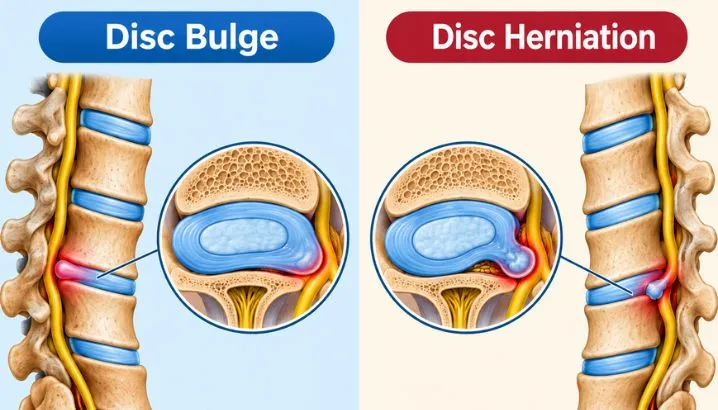
A disc bulge happens when a spinal disc extends beyond its usual boundary, usually over a broader portion of the disc.
Your spine has small cushions called discs between the vertebrae. Each disc has a tougher outer layer and a softer inner portion. These discs help absorb load and allow the spine to move.
As discs age, they can lose flexibility and gradually change shape. This may result in a bulging disc.
A bulge doesn't necessarily mean that the disc has ruptured. Many people can have a disc bulge on an MRI without having any pain at all.
For an independent reference on this exact distinction, from protrusion (bulge) through to extrusion and sequestration (true herniation), the NIH's overview of slipped disc covers the different stages in more technical detail.
What happens when a disc becomes herniated?
A herniated disc occurs when the inner material pushes through a crack or defect in the tougher outer layer of the disc.
This is different from a broad disc bulge because the displaced material is more focal. Depending on its position, it may irritate or compress a nearby nerve.
This can produce symptoms such as shooting pain, numbness, tingling, or muscle weakness in the area supplied by that nerve.
The term "slipped disc" is also commonly used by patients for this condition, although the disc doesn't literally slip out of the spine.
So, what is the real difference between the two?
The main difference is how the disc material extends beyond its normal boundary.
With a bulge, the disc generally extends outward over a broader area. With a herniation, a more focal portion of the disc moves through a defect in the outer layer.
I also want you to remember one important point: herniation does not automatically mean that your condition is severe, and a bulge does not automatically mean that your symptoms are mild.
A small disc herniation in exactly the wrong location can irritate a nerve and cause substantial leg or arm pain. On the other hand, a larger-looking bulge may cause no symptoms.
The MRI description should always be matched with what you are actually experiencing.
| Aspect | Disc Bulge | Disc Herniation |
|---|---|---|
| What it is | The disc extends outward broadly around part of its circumference. | A more focused portion of the disc pushes through a tear or weakened area in the outer layer. |
| Extent | Usually involves a larger portion of the disc’s edge. | Usually involves a smaller, more localized area. |
| Outer disc layer | The outer layer generally remains intact, although it may be stretched or weakened. | The outer layer may develop a tear, allowing the inner disc material to protrude. |
| Nerve pressure | May or may not press on nearby nerves. | Can be more likely to irritate or compress a nearby nerve, depending on its location and size. |
| Symptoms | May cause back or neck pain, stiffness, or no symptoms at all. | May cause pain, tingling, numbness, or weakness when a nerve is affected. |
| Severity | Not necessarily less serious just because it is called a bulge. | Not necessarily more serious; severity depends on nerve involvement and symptoms. |
| Treatment | Often managed with physiotherapy, activity modification, medicines, and other conservative measures when appropriate. | Treatment may also begin conservatively; severe or persistent nerve compression may require further evaluation. |
| Diagnosis | Usually identified through imaging such as MRI, along with clinical examination. | Usually identified through MRI and clinical examination. |
What symptoms can a bulging or herniated disc cause?
Disc-related symptoms depend mainly on where the disc problem is and whether it affects a nerve.
If the problem is in your lower back, you may experience:
- Lower back pain
- Pain travelling into the buttock or leg
- Sciatica
- Tingling or numbness
- Weakness in the leg or foot
If the disc problem is in your neck, symptoms may include:
- Neck pain
- Pain around the shoulder
- Pain travelling into the arm or hand
- Tingling or numbness
- Weakness in the arm or hand
These are common disc bulge symptoms, but not everyone with a disc abnormality experiences them.
Why can the MRI look serious when I don't have much pain?
An MRI shows the structure of your spine, but it doesn't measure how much pain you should feel.
This is something I explain to patients quite often. Two people can have similar-looking disc changes on an MRI but completely different symptoms.
A disc finding becomes more clinically relevant when it matches your symptoms and examination. For example, if an MRI shows a disc pressing on a nerve and you also have pain, numbness or weakness in the area supplied by that nerve, the finding may be meaningful.
Don't judge your condition only by words such as "bulge", "protrusion" or "herniation" in the MRI report.
How are these disc problems diagnosed?
Diagnosis starts with your symptoms and a physical examination, not with the MRI report alone.
During an evaluation, I may assess:
- Where your pain begins and where it travels
- Muscle strength
- Sensation in your arms or legs
- Reflexes
- Walking and movement
- Signs of nerve irritation
An MRI can show the location and nature of a disc abnormality. In selected situations, an EMG or nerve study may also help assess nerve function.
The goal is not simply to find an abnormal disc. The goal is to determine whether that disc explains your symptoms.
Can a disc bulge or herniation heal without surgery?
Yes, many people with symptomatic disc problems improve with non-surgical treatment.
Depending on your condition, treatment may include appropriate pain-relieving medicines, activity modification, physiotherapy, and a gradual return to normal movement.
I generally don't want patients to become afraid of movement. Prolonged bed rest is not routinely recommended for ordinary back pain, and staying gently active is often part of recovery.
Physiotherapy can help improve movement, strength, posture, and the way you use your spine. The exercises should be selected according to your symptoms rather than copied from a random online video.
If sciatica specifically is part of your picture, Can Physiotherapy Cure Sciatica? goes deeper into what that targeted rehab actually involves and how much it can realistically achieve on its own.
When is surgery considered?
Surgery is considered when symptoms or neurological problems indicate that removing pressure from a nerve may be necessary.
For example, surgery may be discussed when:
- Severe symptoms continue despite appropriate non-surgical treatment
- Pain remains disabling and is linked to a clear disc problem
- Muscle weakness develops or progresses
- There is significant nerve compression
- Emergency symptoms involving bowel or bladder control occur
A procedure such as a discectomy may remove the part of the disc that is pressing on a nerve.
If you're at the point of weighing this option, How to Cure Herniated Disc? covers the fuller range of treatment paths, conservative through surgical, so you can see where this decision sits in the bigger picture.
An MRI showing a herniation by itself is not a reason for surgery. The decision should consider your symptoms, examination, imaging, and overall clinical situation.
What should I avoid if I have a disc problem?
You don't need to stop all physical activity, but you should avoid movements that clearly increase your symptoms.
For example:
- Avoid lifting heavy objects without proper technique
- Avoid repeated bending and twisting when your back is painful
- Don't suddenly return to intense workouts
- Don't perform aggressive stretches without guidance
- Don't ignore increasing numbness or weakness
At the same time, avoiding movement completely can make recovery harder. A controlled return to activity is usually more useful than being afraid of every movement.
How can I protect my spine in the long term?
Good spine habits can reduce unnecessary stress on your back and help you maintain strength and mobility.
I recommend focusing on:
- Regular walking and appropriate exercise
- Strengthening your core and back muscles
- Maintaining a healthy body weight
- Using proper lifting techniques
- Taking movement breaks during long periods of sitting
- Maintaining a comfortable working posture
- Avoiding smoking
Age-related disc changes cannot always be prevented, but you can take practical steps to keep your spine strong and your body active.
How To Fix Lower Spine Pain covers this same territory from a broader angle, useful if your concern extends beyond disc-specific issues to general spine health.
When should I see a spine specialist?
You should arrange a medical evaluation if back or neck pain is persistent, keeps returning, travels into your arm or leg, or is associated with numbness or weakness.
Don't wait for symptoms to become severe before getting assessed. A proper examination can help determine whether your pain is coming from a disc, muscle, joint, nerve, or another spinal condition.
Seek urgent medical attention if back pain is accompanied by new difficulty controlling your bladder or bowel or other rapidly developing neurological problems.
If you need evaluation for a disc-related problem, you can consult Dr. Prashant Munde at Lokmanya Hospitals, Pune, where your symptoms and imaging can be assessed together to plan appropriate spine care.
Frequently Asked Questions
1. Is a herniated disc worse than a bulging disc?
Not necessarily. A herniated disc can be more likely to irritate a nerve, but the actual impact depends on its location, nerve involvement, and your symptoms.
2. Can a disc bulge turn into a herniated disc?
Disc degeneration and structural changes can progress over time, but a bulge does not automatically become a herniation. Your symptoms and imaging need to be followed based on your individual condition.
3. Can I walk if I have a disc problem?
Yes, gentle walking is often appropriate if it doesn't increase your symptoms. I usually advise patients to stay mobile within their comfort level rather than remain in bed for long periods.
4. Can I exercise with a herniated disc?
Yes, but the exercise needs to match your symptoms and stage of recovery. Avoid heavy or painful movements until you've been properly assessed.
5. Is sitting bad for a bulging disc?
Long periods of sitting can aggravate back symptoms in some people. I recommend changing position regularly and taking short movement breaks instead of staying in one posture for hours.
6. Can sleeping on the wrong side cause a disc herniation?
Sleeping position alone usually isn't considered a direct cause of disc herniation. However, an uncomfortable position may aggravate existing back or neck symptoms.
7. Can a herniated disc come back after treatment?
Yes, symptoms can recur in some people. Maintaining strength, healthy movement habits, appropriate body weight, and good lifting technique can help protect your spine.
8. Do I need an MRI for every episode of back pain?
No, an MRI isn't necessary for every case of back pain. I recommend imaging when your symptoms, examination, duration, or neurological findings make it clinically appropriate.
9. Can a disc problem cause leg weakness?
Yes, a disc affecting a nerve can cause muscle weakness in the leg. New or worsening weakness should be assessed promptly.
10. Does having a disc herniation mean I will need surgery later?
No, having a herniation does not mean you will eventually need surgery. Many people improve with appropriate non-surgical care, while surgery is reserved for selected situations.
Final Thoughts
When you see "disc bulge" or "disc herniation" on an MRI report, it's natural to feel worried. But the MRI finding is only one part of the picture.
In my practice, I focus on the complete picture: your pain, nerve symptoms, physical examination, MRI findings, and how you respond to treatment. The right approach may be conservative care, rehabilitation, or, in selected cases, surgery.
A disc problem should be assessed, not feared. Understanding what your MRI actually means is the first step toward choosing the right treatment.
Medical Disclosure
This article is intended for general health education and does not replace an individual medical consultation. Treatment for a disc bulge or herniation should be decided after assessment by a qualified healthcare professional, especially when you have weakness, numbness, severe pain, or bowel or bladder changes.
Previous blog