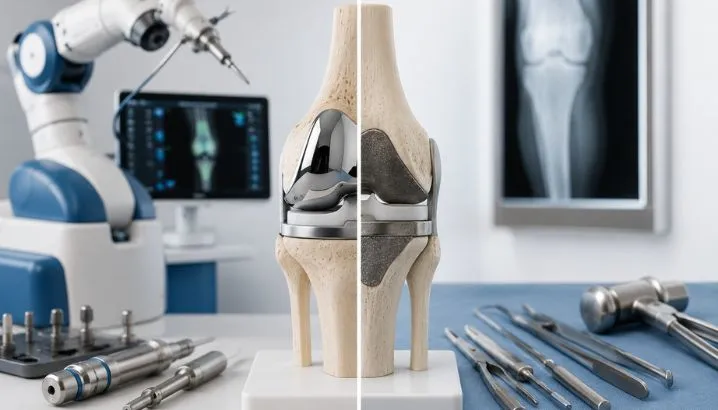
Robotic vs. Traditional Knee Replacement: Which Is Right for You?
Category: Orthopedics
 Fri Aug 14 2026


Patients ask me this question almost every week: is robotics really better, or is it just newer and more expensive?
I'm Dr. Satish Kale, Consultant Robotic Joint Replacement, Arthroscopy & Sports Injury Surgeon at Lokmanya Hospitals, Pune, and the honest answer is that robotic knee replacement treatment isn't automatically the right choice for every patient, it depends on your knee, your goals, and a few practical factors we'll walk through here.
Key Takeaways
- Both techniques replace the same damaged joint, the difference is in planning and precision, not the implant itself
- Robotic vs traditional knee replacement comes down to accuracy of alignment, not a guarantee of a pain-free surgery
- Not every patient is an ideal candidate for robotic surgery
- Cost difference in Pune is real, but so is the difference in long-term implant positioning for some patients
- The right choice depends on a conversation with your surgeon, not a trend
What's the Real Difference Between Robotic and Traditional Knee Replacement?
Both procedures remove the damaged part of your knee joint and replace it with an implant. What differs is how precisely that plan is executed.
| Traditional Knee Replacement | Robotic Knee Replacement | |
|---|---|---|
| Planning | Based on X-rays and surgeon's intraoperative judgment | Built from a 3D model of your knee before surgery |
| Execution | Manual instruments and alignment guides | Robotic arm guides cuts within a fraction of a millimeter of the plan |
| Incision size | Typically longer | Often smaller, though this varies by surgeon and case |
| Track record | Decades of long-term outcome data | Growing but shorter-term data, generally favorable so far |
| Best suited for | Most standard cases, including complex deformities in experienced hands | Cases where fine alignment and soft-tissue balancing matter most |
Neither approach changes the fundamental goal, a well-positioned, well-balanced implant that lasts. The tools just differ in how consistently they get you there.
How Does the Surgery Itself Differ, Step by Step?
The core surgical steps are the same, what changes is the guidance system behind them.
- In traditional knee replacement recovery planning, I rely on X-ray imaging and years of hands-on judgment to size and align the implant during surgery
- In robotic-assisted total knee replacement (TKR), a preoperative scan builds a patient-specific 3D map of your knee before you even enter the operating room
- During surgery, the robotic arm provides real-time feedback, helping me stay within the planned boundaries while I still control every movement
- This is computer-assisted surgery, not automated surgery, the robot doesn't operate on its own, it assists my hands
Does Robotic Surgery Actually Hurt Less or Heal Faster?
Often, but not universally, and it depends heavily on the individual case.
- Robotic-assisted knee arthroplasty tends to involve smaller incisions and less disruption to surrounding soft tissue in many patients
- Several published outcome comparisons report fewer readmissions and somewhat faster early mobilization with robotic techniques
- That said, an experienced surgeon performing traditional surgery can also achieve excellent alignment and low complication rates; technique and volume matter as much as the tool
- Minimally invasive surgery benefits are real, but they're not exclusive to robotic cases
Is Robotic Knee Replacement Right for Everyone?
No, and any surgeon telling you it's the automatic best option for every patient isn't giving you the full picture.
- Patients with severe bone deformity, certain prior hardware, or specific anatomical challenges may still be better served by an experienced surgeon's traditional approach
- Osteoarthritis severity, bone quality, and your overall activity goals all factor into which technique fits your knee.
- If you want a plain-language overview of osteoarthritis prevalence and progression, this NIH-hosted overview covers the Indian epidemiological picture in detail.
- Robotic planning requires additional imaging and setup time, which isn't always necessary for straightforward cases
- I make this decision case by case, after examining your knee and imaging, not based on which technology is newer
How Do the Two Compare on Cost in Pune?
Robotic surgery typically costs more, largely due to the additional imaging, planning software, and per-case technology fees.
- Knee replacement surgery in pune pricing for traditional TKR generally runs lower than robotic-assisted procedures at most hospitals in the city
- Robotic-assisted cases usually add a percentage premium over conventional surgery, largely tied to technology usage charges
- Insurance coverage for the robotic premium varies by policy; it's worth confirming with your insurer before deciding
- Cost shouldn't be the only deciding factor, but it is a legitimate, practical one for many families. If you want the specific numbers behind total, partial, and robotic procedures in the city, I've broken that down separately in Knee Transplant Cost in Pune, India.
What Does Recovery Actually Look Like With Each Approach?
Recovery timelines overlap more than marketing material usually suggests.
- Most patients, robotic or traditional, begin walking with support within a day or two of surgery
- Physiotherapy protocols are largely similar across both approaches; consistency in rehab matters more than which technique was used
- Robotic patients sometimes report a smoother early recovery window due to reduced soft-tissue trauma, though individual healing still varies widely
- Full functional recovery for either technique typically takes several weeks to a few months, depending on your baseline fitness and how consistently you follow physiotherapy
Which One Is Right for You?
Ask your surgeon these questions before deciding; they matter more than the technology itself:
- What does my specific knee anatomy and deformity suggest about which technique fits best?
- How many robotic and how many traditional cases have you personally performed?
- What's the realistic cost difference for my case, including the implant and hospital stay?
- What's your complication and revision rate with each approach?
If you're weighing robotic vs traditional knee replacement and want an honest assessment specific to your knee, I see patients for joint replacement, arthroscopy, and sports injury consultations at Lokmanya Hospitals in Pune. You can see the full scope of our joint, hip, and knee replacement program here.
Final Thoughts
Neither robotic nor traditional knee replacement is universally "better"; they're two well-established ways of reaching the same goal: a stable, well-aligned knee that lets you move without pain.
The right choice depends on your anatomy, your surgeon's experience with each technique, and your own priorities around cost and recovery, not on which one sounds more advanced.
A thorough examination and an honest conversation with your surgeon will tell you far more than any comparison article can.
Frequently Asked Questions
Does robotic knee replacement hurt less than traditional surgery?
Many patients report less early discomfort due to smaller incisions and reduced soft-tissue disruption, but pain experience varies by individual and surgical skill.
Can everyone get robotic knee replacement?
No, patients with certain bone deformities, prior implants, or specific anatomical challenges may be better suited to a traditional approach.
How much does robotic knee replacement cost in Pune?
It typically costs more than traditional TKR due to added imaging and technology fees, the exact difference varies by hospital and case complexity.
Is robotic knee replacement worth the extra cost?
For patients needing precise alignment or complex soft-tissue balancing, many surgeons feel it's worthwhile, but it isn't essential for every case.
How long does robotic knee replacement recovery take?
Most patients walk with support within a day or two, with full functional recovery over several weeks to a few months, similar to traditional surgery timelines.
Is traditional knee replacement outdated?
Not at all, it has decades of strong long-term outcome data and remains an excellent option in experienced hands.
Which technique has a lower risk of complications?
Both carry low complication rates in experienced hands, the surgeon's skill and case volume matter more than the tool used.
Do robotic knees last longer than traditional ones?
Long-term data on robotic implants is still accumulating, but early alignment accuracy is associated with better implant longevity in general.
Will my insurance cover robotic knee replacement?
Coverage varies by policy, it's best to confirm the exact robotic-related charges with your insurer before scheduling surgery.
How do I know which technique is right for my knee?
A physical examination and imaging review with your surgeon is the only reliable way to determine this, not general online comparisons.

Dr. Satish kale
- MBBS, DNB, D Ortho
Consultant Robotic Joint Replacement, Arthroscopy & Sports Injury Surgeon